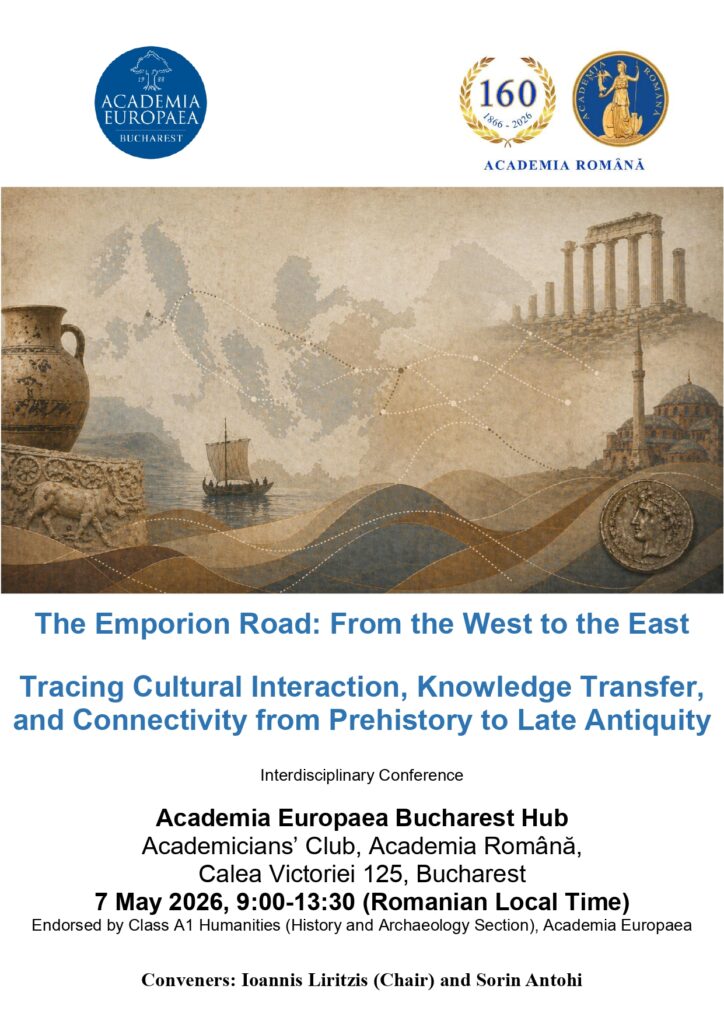
The Emporion Road: From the West to the East
Tracing Cultural Interaction, Knowledge Transfer, and Connectivity from Prehistory to Late Antiquity
Interdisciplinary Conference
Academia Europaea Bucharest Hub
Academicians’ Club, Academia Română, Calea Victoriei 125, Bucharest
7 May 2026, 9:00-13:30 (Romanian Local Time)
Endorsed by Class A1 Humanities (History and Archaeology Section), Academia Europaea
Conveners: Ioannis Liritzis (Chair) and Sorin Antohi
To mark the first anniversary of the Academia Europaea Bucharest Hub (established on 9 May 2025 on the basis of an agreement between the Academia Europaea and the Romanian Academy), the first edition of the Hub Days is organized. Two public interdisciplinary conferences are convened on 7-8 May: AI: Beyond Humanity, and The Emporion Road: From the West to the East.
On this occasion, the creation of the Hub’s Cantemir Medal and Ioan Petru Culianu Prize will be announced. The two distinctions are endorsed by the Board of the Academia Europaea.
The event is generously sponsored by the Romanian Academy and Banca Transilvania, and supported by numerous partners.
Videos of the event will be streamed, then archived on the Hub’s homepage (www.acadeurobucharest.eu) and YouTube Channel (Academia Europaea Bucharest Hub – YouTube).
Join Zoom Meeting
https://us06web.zoom.us/j/85355139883?pwd=FDbrFCVRLg8bobmNsvN0NmPbtiYx4b.1
Meeting ID: 853 5513 9883
Passcode: 876241
Conference Aims and Conceptual Framework
The conference seeks to advance scholarly understanding of long-term West–East cultural interaction, emphasizing not only trade routes but the transfer of ideas, technologies, symbolic systems, and methods of knowledge production from prehistory through later antiquity.
While the Silk Road has long dominated narratives of East–West connectivity, this conference foregrounds earlier and parallel interaction networks—maritime, overland, and hybrid—that linked the Aegean, Anatolia, the Near East, the Black Sea, the Steppe corridors, Central Asia, and beyond. These networks functioned as dynamic systems of exchange, facilitating the circulation of scientific practices, artistic styles, religious concepts, educational traditions, and philosophical thought, as well as goods.
A core objective is to move beyond diffusionist or unilateral models and instead examine reciprocal influence, hybridity, and cultural translation. The conference emphasizes evidence-based reconstruction, integrating archaeological datasets, textual sources, linguistics, scientific methods, digital tools, and comparative cultural analysis to better understand how knowledge was transmitted, adapted, and transformed across cultural frontiers.
Special attention will be given to:
- Mechanisms of interaction (emporia, itinerant specialists, merchants, diplomats, scholars).
- Media of transmission (material culture, language, education, ritual practice).
- Archaeological and scientific witnesses as data carriers of intercultural exchange.
- Methodological innovation, including digital humanities, archaeometry, network analysis, and AI-assisted data synthesis.
The conference aims to produce a step forward in interdisciplinary knowledge integration, offering new models for understanding early globalization, intercultural consciousness, and the foundations of later East–West intellectual encounters.
PROGRAM
PART I
9:00-11:00
Sorin Antohi, Moderator and Opening Remarks: From One-Way and Asymmetrical Diffusion to Entangled Transfers and Multiple Origins
Ioannis Liritzis, The Emporion Road: Presentation of the Project
Alexander Westra, The Emporial System: A Structure of Eurasian Exchange
Lusha Guo, Guang Yang, Beyond the Handle: Cultural Flows and the Transformation of Ceramic Single Dragon-Handled Ewers in Medieval China
Anca Dan, Greco-Iranian Entanglements Throughout Eurasia, from Classical/Achaemenid to Roman/Sassanian Times
Discussion
11:00-11:30 Coffee
PART II
11:30-13:30
Ioannis Liritzis, Moderator and Closing Remarks
Elias K. Petropoulos, From Mycenaean Kings to Alexander’s Oikoumene:
Anatolia as a Long‑Duration Corridor of Cultural Translation Between
West and East (14th–4th c. BCE)
Lukas Nickel, Technology Transfer to and from China in the 3rd Century BC
Enrico Morano, Western Influences in the Manichaean Sogdian Texts from Turfan
Richard Lim, The A.D. 166 Roman Embassy to Han China in Light of Cultural Knowledge and Long-Distance Exchanges
Xenophon Moussas, Mapping the Cosmos, Crossing the Seas: Hellenistic Genius of Antikythera Mechanism and the Route to Ancient China.
Discussion
*
Sorin Antohi sorin.n.antohi@gmail.com in person
Anca-Cristina Dan anca-cristina.dan@ens.psl.eu in person
Richard Lim rlim@smith.edu online
Ioannis Liritzis liritzis@aegean.gr in person
Lusha Guo lusha@henu.edu.cn (with Guang Yang) online
Enrico Morano ec.morano@gmail.com in person
Xenophon Moussas xmoussas@phys.uoa.gr, xdmoussas@gmail.com online
Lukas Nickel lukas.nickel@univie.ac.at in person
Elias K. Petropoulos ipetropo@hs.duth.gr in person
Alexander Westra alexanderwestra@hotmail.com, westra@henu.edu.cn online
*
Sorin Antohi
Executive Director, Academia Europaea Bucharest Hub
Opening Remarks: From One-Way and Asymmetrical Diffusion to Entangled Transfers and Multiple Origins
As most fields in the emerging and maturing humanities and social sciences were undergoing a period of intensive creation of discipline-specific, identity-making concepts, paradigms, and theories, the late 19th-century and the early 20th-century were privileging one-way and asymmetrical diffusionism (from imperial/colonial imposition to imitation to mimetic competition to dialogue) to account for similarities between (mental) objects, worldviews, practices, and processes in distant places. But the paradigm of exchange, of two- or multiple- way diffusion was never too far. Whenever transmission was difficult, if not impossible to document, imagination intervened, and connections were first construed, and later (in most cases) attested. With the birth of structuralisms in the early 20th-century, the paradigm of multiple origins (fully or partially independent) started to gain ground. My brief remarks follow these epistemological transitions all the way to morphodynamics and the cognitive sciences.
*
Anca Dan
Professeure attachée à l’Ecole Normale Supérieure, Paris
Chargée de recherche, CNRS, Archéologie et Philologie d’Orient et d’Occident
Greco-Iranian Entanglements Throughout Eurasia, from Classical/Achaemenid to Roman/Sassanian Times
Generally perceived as two antagonistic civilizations, based on the Athenocentric rhetoric following the Greco-Persian Wars, Hellenic and Iranian cultures mutually influenced each other and gave rise, on the fringes of their respective empires, to Mixhellenic, hybrid cultures that were no less valuable. In this presentation, we will use archaeological and historical examples from emporia, located throughout Eurasia, to show how the Greeks and Persians contributed to the development of Thracian, Scythian, Bactrian, and Sogdian knowledge and art between the 6th century BC and the 7th century AD. These collective identities—Thracian, Scythian, Bactrian, and Sogdian—known primarily from Greek and Iranian texts and through objects influenced by Greek and Persian culture, represent “middle grounds” to be studied from a postcolonial perspective, abandoning an exclusively Eurocentric or “Orientalist” view. Indeed, the study of cultural exchanges between the two great powers of Europe and Asia and their “barbarian” worlds allows us to examine the role of emporia as centers for the exchange of ideas, techniques, and materials in the ancient world. We will therefore see that the emporia – that is to say, the places of trade (whether they were ports or crossroads or stations on caravan routes) – are only the most “democratic” or the most “popular” of the places of cultural transfers which take place in multiple ways, in all possible places, even between worlds at war.
*
Richard Lim
Professor of History, Smith College, Northampton, Mass., USA
The A.D. 166 Roman Embassy to Han China in Light of Cultural Knowledge and Long-Distance Exchanges
The arrival of western envoys claiming to represent ‘Andun, king of Daqin’ at the Han frontier in A.D. 166—recorded in the Hou Han Shu and traditionally regarded as the first official contact between Rome and China—offers a compelling case study for the conference theme of West–East cultural interaction and connectivity. This paper investigates several fundamental questions related to this little-known expedition: who actually sent this mission and for what reasons, and what mechanisms of interaction enabled its remarkable journey from the Mediterranean to present-day northern Vietnam? Drawing on the textual analysis of Chinese and Graeco-Roman sources, reconstructions of cultural and geographical knowledge as well as maritime and overland routes operative in this period, I seek to identify not only the agents, motives, emporia, and long-distance networks that stood behind this venture but also to offer some observations regarding how the embassy speaks to the construction of cultural knowledge on opposing ends of Eurasia during this time.
*
Ioannis Liritzis
Professor of Archaeometry-Natural Sciences, University of the Aegean, Rhodes, Greece. European Academy of Sciences & Arts (Salzburg) – Dean of Class IV Natural Sciences (2021-2025) – Vice President (2025-2030), Fellow, World Academy of Art and Science; Distinguished Professor, Institute of Capital Civilization and Cultural Heritage, Henan University, China (2018- ), Distinguished Professor, Alma Mater Europaea, Maribor, Slovenia (2022- ), Member, Academia Europaea (2025); Membre par Correspondance de L’ Académie des Sciences, Arts et Belles-Lettres de Dijon; Guest Professor South China University of Technology, China.
The Emporion Road: Presentation of the Project
The presentation introduces the concept of the “Emporion Road” as a new interpretive framework for understanding ancient connectivity across Eurasia. While the Silk Road has dominated scholarly and public imagination, it represents a relatively late and geographically narrow phase of exchange focused largely on luxury goods and east–west movement. In contrast, the Emporion Road offers a deeper, broader, and more integrated model of interaction spanning from prehistory to late antiquity.
The term emporion (trading post) is central: it refers not to a single route but to a network of interconnected hubs where goods, people, and critically, ideas were exchanged and transformed. These nodes linked the Aegean, Near East, Black Sea, Central Asia, and beyond, combining maritime and overland routes into a unified system of mobility and contact.
Three defining principles structure the concept:
(1) Temporal depth, extending back to the Bronze Age and Neolithic, incorporating Mycenaean, Phoenician, Achaemenid, Hellenistic, and Roman–Sasanian interactions;
(2) Spatial breadth, including maritime and inland corridors across Eurasia;
(3) a conceptual shift from diffusion and influence toward translation, hybridity, and co-creation of knowledge and material culture.
The programme is organized into nine thematic axes, covering connectivity, scientific and technical knowledge transfer, arts and symbolism, religion, economy, language, philosophy, archaeological evidence, and methodological innovation. Particular emphasis is placed on underexplored areas such as the transmission of scientific knowledge, multilingual communication systems, and new digital/AI-driven archaeological methods.
Three new interpretative insights are highlighted:
First, the Emporion Road functioned as a failure-tolerant system, where risk was mitigated through kinship, credit, temples, arbitration, and diplomatic institutions, making long-distance exchange resilient and repeatable.
Second, “empty emporia”—seasonal or intermittently used nodes—were crucial parts of the network, where timing and knowledge of access were more important than permanent settlement.
Third, the system fostered early forms of peacebuilding, generating treaties, alliances, shared sanctuaries, and negotiation practices that structured intercultural coexistence without eliminating conflict.
The presentation concludes by positioning the Bucharest Hub of the Academia Europaea as a platform for future collaboration. Planned outputs include a peer-reviewed volume, a digital atlas of emporia, and a major ERC/Horizon Europe proposal on knowledge transfer systems in antiquity.
Ultimately, the Emporion Road is framed not as a single historical route, but as a polyphonic system of human interaction, where exchange was continuous, multi-directional, and deeply creative—composed of countless everyday encounters that shaped the ancient world.
*
Lusha Guo, Guang Yang
Lusha Guo, Lecturer, Henan University, School of History and Culture, Kaifeng, China
Guang Yang, Master’s Graduate from Henan University
Beyond the Handle: Cultural Flows and the Transformation of Ceramic Single Dragon-Handled Ewers in Medieval China
This research investigates the single dragon-handled ewer, a distinctive ceramic type that emerged during the period from the Northern and Southern Dynasties to the Sui Tang era (5th to 9th centuries CE). This era witnessed unprecedented cultural interaction along the Silk Road and maritime routes, making material culture an invaluable lens for examining cross-cultural exchange mechanisms. The study asks: How did multiple foreign influences, including Roman Byzantine, Persian Sasanian, and Central Asian nomadic aesthetics, interact with native Chinese ceramic traditions to shape the evolution of this vessel type? The objective is to trace the specific pathways of knowledge transfer and artistic syncretism that transformed a local form into a cosmopolitan artifact. The research is based on systematic analysis of 42 archaeologically excavated specimens from key sites across both southern (Nanjing region) and northern (Henan, Hebei, Shaanxi) cultural spheres. The methodology employs a dual approach: typological analysis establishing a classification system (2 types, 6 subtypes) forming the basis for a three-phase chronological sequence, combined with contextual and comparative analysis correlating morphological changes with historical records of population movement and cultural contacts. The research demonstrates a three-phase evolutionary trajectory. Phase 1: Liu Song period of Southern Dynasties (5 century CE) shows the form originating from indigenous chicken-spouted ewer traditions, creatively incorporating a Roman Byzantine “snake-mouth gripping the lip” handle concept received via maritime routes. Phase 2: the late Northern Wei to Northern Zhou period of Northern Dynasties (6 century CE ) reveals the production center shifting north, where vessels absorbed Sasanian Persian animal imagery and Buddhist decorative motifs. Phase 3: Sui and Tang (7th to 9th centuries CE) documents diversification as foreign elements were internalized into a distinctly Tang aesthetic across multiple kiln traditions. This research contributes to understanding West East interaction by moving beyond simplistic “influence” models to illustrate complex cultural translation and hybridity. It demonstrates how foreign motifs were actively re-interpreted within Chinese technical traditions and symbolic systems, population migration, and technical diffusion that connected West and East, illuminating the dynamic processes of early globalization.
*
Enrico Morano
Independent scholar. Retired High School teacher. Member of the Academia Europaea, former President of the International Association of Manichaean Studies (IAMS), Member of the World Philology Union (WPU)
Western influences in the Manichaean Sogdian Texts from Turfan
My research focuses on the Middle Iranian texts from the Turfan Collection in Berlin. I have long been particularly interested in Sogdian Manichaean texts. Sogdian was the lingua franca of the Silk Road for several centuries. The study of these texts, many still unpublished, reveals important cultural contacts and influences between the Western and Eastern worlds. Philological and cultural issues will be explored to highlight these contacts. In particular, fragments of a work by Mani, The Book of Giants, will be examined to determine the Jewish influence on this work, which Mani reworked from an Aramaic pseudepigraphic text, fragments of which are found in the Qumran finds. Also of notable importance is the diffusion of short stories, often used to construct parables in Manichaeism. Some of these are clearly Aesopian in nature.
*
Xenophon Moussas
Department of Astrophysics, Astronomy and Mechanics, Faculty of Physics, School of Science, National and Kapodistrian University of Athens
The Mechanical Cosmos and the Sea Road to the Sinae
The Antikythera Mechanism serves as the definitive intersection of Hellenistic mathematical engineering and the expansionist ambitions of ancient maritime trade. As a mechanical model of the heavens, this device—utilizing over 30 bronze gears and sophisticated epicyclic (pin-and-slot) gearing—represented the “software” of antiquity. It translated complex lunar cycles and lunisolar calendars into a predictable, hand-cranked interface, mimicking the moon’s variable motion a millennium before such technology reappeared in Europe.
While primarily a terrestrial teaching tool, the mechanism’s reliance on spherical trigonometry and solar-lunar data provided the essential backbone for long-distance navigation. By quantifying the Metonic and Saros cycles, Hellenistic science offered the mathematical certainty required for mariners to leave the sight of land, navigating the perilous waters between the sub-arctic Thule and the trade hubs of Han Dynasty China. This intellectual network viewed the Earth and Heavens as a singular, calculable system, transforming the 5,000-mile journey to the East from a feat of mere bravery into a triumph of applied spherical geometry and astronomy.
This scientific tradition culminated in Claudius Ptolemy’s Geographia, which revolutionized the ancient oikoumene by establishing a formal grid of latitude and longitude. By utilizing astronomical observations—such as solar altitudes—to fix terrestrial locations, Ptolemy converted vague travelers’ tales into a systematic map stretching to the “Sinae.” Although his Book 7 coordinates for regions east of India exhibit a systematic “longitudinal stretch” due to an underestimated Earth circumference, his use of conic and stereographic projections provided the first rigorous framework for global geography. Together, the Antikythera Mechanism and Ptolemaic mapping prove that the ancient sea road was paved with sophisticated mathematical engineering, bridging the gap between the edge of the world and the Middle Kingdom.
*
Lukas Nickel
Professor, Institute of Art History, Vienna University
Technology Transfer to and from China in the 3rd Century BC
The study of cross-Eurasian contact cannot rely singularly on the – often patchy – literary transmission. Researching non-literary evidence such as the adoption of artistic media, object types and shapes, and motifs, allows insight into periods of exchange that left little trace in the written record.
In this respect the migration of technologies deserves special attention. Mastering technologies such as bronze or silver casting requires various complex skill sets that in their original environment had been the result of developments lasting centuries. Such skills cannot be passed on easily. Getting hold of and inspecting a final product made using an alien method is usually insufficient to learn how to replicate the product and its technology. Instead, the transmission requires communication between specialists as well as training. Thus, the migration of technologies reveals moments of direct and especially intense contact and negotiation between societies.
This talk will outline the emergence of several new technologies in China in the late 1st millennium BC. It will trace their origins and discuss the significance of their adoption.
*
Elias K. Petropoulos
Professor of Ancient History, Democritus University of Thrace, Department of Humanities, Komotini, Greece
From Mycenaean Kings to Alexander’s Oikoumene: Anatolia as a Long-Duration Corridor of Cultural Translation between West and East (14th – 4th c. BCE)
Current research on ancient connectivity increasingly challenges diffusionist interpretations of East–West interaction, emphasizing instead multidirectional exchange and processes of cultural translation. Responding to this shift, the present paper examines Anatolia (Asia Minor and adjacent areas) as a structurally persistent corridor of intercultural connectivity linking the Aegean, the Near East, and the eastern Mediterranean from the Late Bronze Age to the age of Alexander the Great (14th – 4th centuries BCE). Rather than approaching the region as a geopolitical frontier, the study conceptualizes Anatolia as an active mediating zone in which political concepts, ritual practices, administrative systems, and symbolic frameworks were continuously negotiated and reformulated.
The paper addresses the following research question: how did mechanisms of knowledge transfer operate across successive historical systems, and in what ways did intercultural networks maintain continuity despite political collapse and imperial transformation? The analysis integrates textual, archaeological, and comparative historical evidence, including Hittite diplomatic archives and the Ahhiyawa corpus, Mycenaean–Anatolian material interactions, Neo-Hittite and Luwian cultural continuities, and the infrastructural and administrative networks of the Achaemenid Empire. Special attention is given to multilingual scribal education, itinerant specialists, and ritual expertise as agents enabling the translation -not merely transmission- of knowledge across cultural boundaries.
Recent developments in digital archaeology and settlement-network analysis further support the interpretation of western Anatolia as a densely interconnected interaction landscape rather than a peripheral contact zone. These findings allow a reassessment of long-term connectivity patterns culminating in Alexander’s oikoumene, interpreted here as the acceleration and expansion of interaction systems that had evolved over nearly a millennium.
By combining historical, philological, and archaeological approaches within a comparative framework, the paper contributes to broader debates on early globalization, intercultural consciousness, and knowledge transfer before the classical Silk Road. It proposes Anatolia as a key analytical model for understanding how cultural frontiers functioned as productive environments of innovation, adaptation, and intellectual exchange between West and East.
*
Alexander Jan Dimitris WESTRA
Henan University, Key Institute for Yellow River Civilization & Sustainable Development, Kaifeng, China
UMR 7041 “ArScAn” (Archéologies et Sciences de l’Antiquité), Équipe “Archéologie de l’Asie centrale”
The Emporial System: Α Structure of Eurasian Exchange
Emporia served as operational settings for long-distance exchange in antiquity. Yet routes labeled “silk,” “tin,” “amber,” or “frankincense” describe visible flows more than they explain how repeatable exchange remained workable across politically fragmented landscapes and shifting regimes. This paper proposes the Emporial System as an analytical model for that mechanism: a recurrent interaction regime, shaped by maritime fragmentation and reinforced through mobility and colonization, that stabilized negotiated access among autonomous communities. Rather than treating emporia only as spatial nodes or treating proxeny, ateleia, asylia, and foreign communities as isolated institutions, the paper examines how shared norms and practices of brokerage, hosting, mediation, protection, and reputational enforcement both shaped and were formalized through these institutional and spatial forms. The Greek maritime world provides a long-term case study because persistent political plurality and coastal accessibility favored exchange strategies oriented toward negotiated access and coexistence, while also showing strong regional and polis-level variation in participation. The paper concludes by outlining evidentiary signatures by which the Emporial System can be identified and compared across contexts: recurrent spatial configurations of emporia and contact zones, patterned institutional repetition in epigraphy and law, literary discourse about foreigners and exchange, and archaeological correlates of sustained foreign presence and interaction.
***